
Introducing Our New Handler Certification One-Pager

At Food Alliance, we often talk about the importance of whole-system sustainability and how responsible practices on the farm must be carried through every step of the supply chain to truly deliver on environmental and social commitments. That’s where our Handler Certification program plays a critical role. To help better communicate this often-misunderstood part of our work, we’ve developed a new Handler Certification one-pager, a concise resource designed to clarify who it’s for, what it requires, and why it matters.
Why Handler Certification Matters
While Food Alliance certification begins at the farm, it doesn’t end there. As products move through processing, manufacturing, and distribution, maintaining integrity becomes more complex and more essential. Handler Certification ensures that:
Certified products remain traceable throughout the supply chain
Environmental and social claims made at the farm level are preserved
There is no substitution or commingling with non-certified products
Beyond traceability, the program reinforces a broader commitment to transparency, accountability, and continuous improvement across the supply chain, core principles that are the foundation of all Food Alliance standards.
Extending Sustainable Practices Beyond the Farm
Food Alliance’s packing and processing standards are designed to ensure that sustainability is not lost once products leave the farm gate. Certification for handlers evaluates not only how products are tracked, but how facilities operate day to day. This includes a comprehensive review of:
Labor practices and worker health and safety
Energy and water use efficiency
Waste management systems
Use and reduction of hazardous materials
Food safety and product quality controls
By addressing both operational impacts and supply chain integrity, Handler Certification helps ensure that sustainability claims are credible, verifiable, and meaningful at every stage.
Who Is It For?
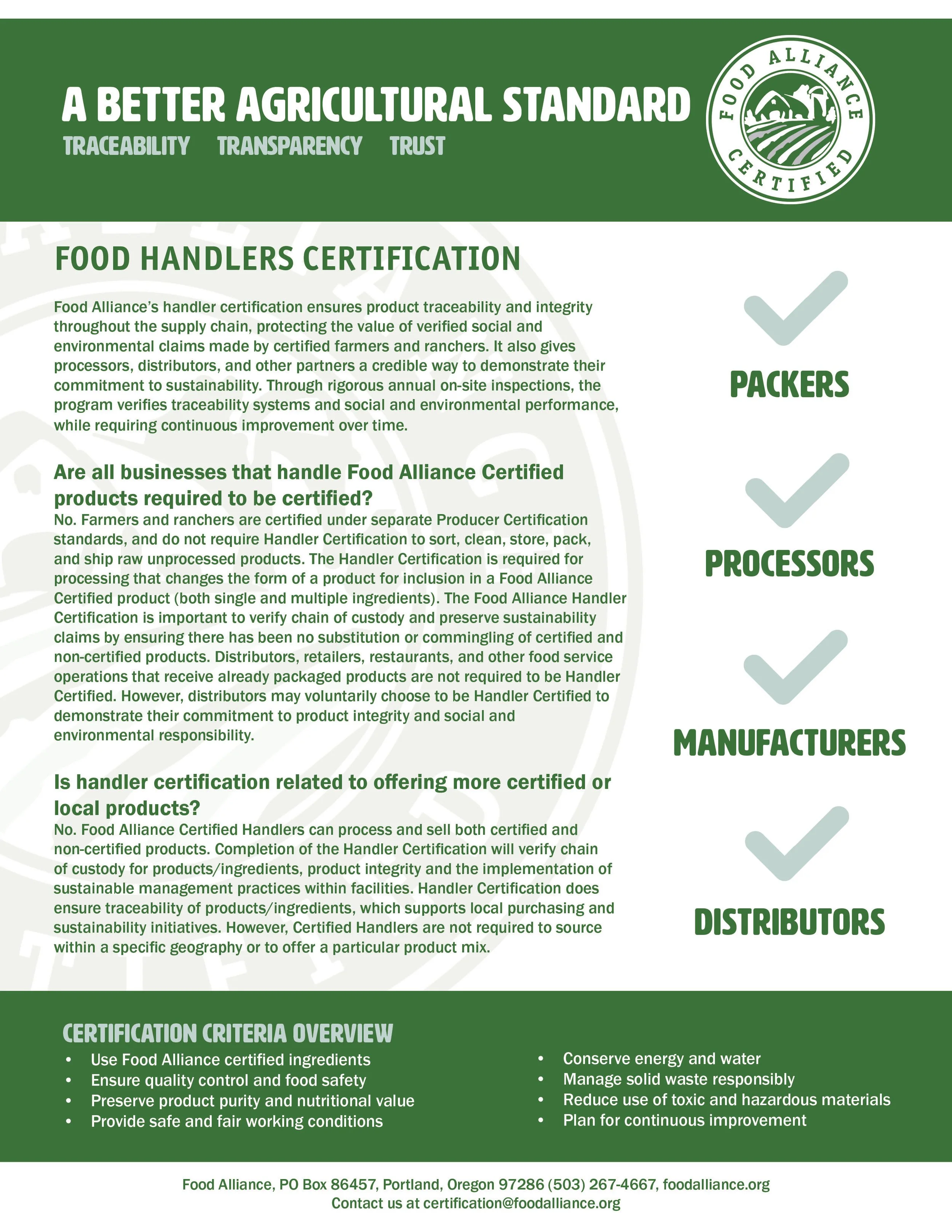
The one-pager highlights the types of businesses that benefit most from Handler Certification, including: Packers, Processors, Manufacturers, and Distributors. These operations are a critical bridge between farms and markets, where products are transformed, aggregated, or prepared for sale. Not every business is required to be certified. Farms operating under Producer Certification can handle raw, unprocessed products without needing Handler Certification. However, once a product is processed or its form changes, especially in multi-ingredient products, Handler Certification becomes essential to verify chain of custody.
Additionally, while distributors and retailers are not required to be certified when handling finished, packaged goods, many choose to pursue certification voluntarily as a way to demonstrate leadership in transparency and responsible sourcing.
The one-pager outlines the core criteria that certified handlers are evaluated against, including:
Product traceability and quality control
Food safety and product integrity
Safe and fair working conditions
Energy and water conservation
Responsible waste management
Reduction of hazardous materials
Ongoing continuous improvement
These standards reflect a systems-based approach ensuring that sustainability is embedded not just in sourcing, but in how businesses operate every day.
A Tool for Partners and Prospective Clients
Whether you’re already working within the Food Alliance network or exploring certification for the first time, this one-pager is designed to be a practical, accessible tool. It can help:
Clarify requirements for internal teams
Support conversations with buyers and partners
Demonstrate your commitment to transparency and accountability
As we continue to expand and refine our communications, resources like this are part of a broader effort to make our standards more transparent, usable, and aligned with the needs of the industry.
If you have questions about Handler Certification or want to explore whether it’s a fit for your operation, we’d love to connect!